
Annah Muli
 Background
I am from Kenya, a beautiful country in East Africa with coastline on the Indian Ocean and encompasses the savannah, lakelands, the dramatic Great Rift Valley and mountain highlands. My graduate academic journey began at the University of Nairobi where I did my bachelor’s degree in statistics and there after a master’s degree in mathematical statistics. I was fortunate to join the IMforFUTURE network at the University of Leeds on August 2018 under the supervision of Prof. Jeanine Houwing-Duistermaat and Dr. Arief Gusnanto.
Research
My research focuses on developing flexible statistical methods for analysis of correlated survival data that will be applied to omics data. Survival data entails data about time to the occurrence of an event and is widely applicable across many disciplines. Overtime, there has been a high reliance on the Cox proportional hazards model for modelling of survival data. The effect of a covariate on the outcome is reported in a hazard rate. However, hazards rates are hard to interpret. Our study considers differences in survival probabilities instead. To model correlation in data, survival models with frailties or random effects is commonly used. However, there is a potential danger of bias in the estimation if the frailty distribution is misspecified. Frailties are often assumed to follow a gamma distribution. We therefore investigate the impact of the misspecification of this distribution on estimation of survival probabilities using simulated data and real (twins) data. Our model fits both parametric and flexible (non-parametric) baseline hazard.
Secondment
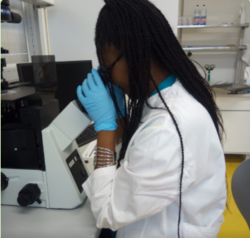 I had the opportunity have my secondment in the wet lab at Biocenter, University of Zagreb, Croatia for one month. During this period I experienced a first hand experience of interdisciplinary collaboration. Things I learnt include process of data measurement in the laboratory, observed how experiments are carried out and how/why there can have variations in the output, role of epigenetics, environment to genes – switch off & switch on, adjustments based on concentration of cells and, protocol for different experiments including DNA methylation. I also realized that the wet lab researchers face challenges such as calculating % of reagents to add, contamination of samples and adjusting procedure for optimal results (its not always easy).
 Public engagement
I took part in a jointly organised public engagement activity that took place in Split, Croatia. The aim was to engage with the general public, disseminating our research as well as the relevance of science and research in general. We engaged the public on general awareness of ageing and the impact of environmental and other factors on ageing and ageing- related diseases.